Showing posts with label berry picking. Show all posts

Sunday, September 1, 2013

Summer Berry Picking

We've done a lot of berry picking this summer.  In our yard (strawberries and blueberries), the wild berries near by (blackberries, thimble berries, salmon berries and huckleberries), and at nearby you-pick farms(strawberries, raspberries and blueberries).   I'd love to say we have a ton of berries stored in the freezer for use year round, but we just eat them too fast and only have a couple pounds of blueberries. Everything else has been eaten.

We did have one traumatic hornet experience at a blueberry farm in Bellevue (Mercer Slough).  Allie got stung and started crying.  She didn't know why she was hurt and couldn't explain it.  While I was trying to get to Allie my nephew got stung and ran to me crying, grabbing my legs so I couldn't get to Allie.  I finally figured out what was going on but didn't realize that the hornets were on the attack.  Floyd and my brother then stormed in grabbed the kids and ran out screaming, "Go, go, go."  Allie and my nephew each got stung two times a piece, and Floyd got stung five times.  Selena and I were lucky to get away unscathed. Fortunately no one had any serious reactions.

The frustrating part was when we reported the nest to the people running the farm they said there wasn't anything they could do.  If they had set up signs and warned people to not go near the nest then the people we saw a half hour later could have avoided getting stung.  Apparently my mom also talked to some people who had got stung their a week prior.  

Blueberries at Mountain View Blueberry Farm

Wild Blackberries

Monday, September 6, 2010

Wild Berries in Western Washington (Blackberries)

This is a continuation of my series on wild berries in the Pacific Northwest.

In the Puget Sound area typically Labor Day weekend is the prime time to pick blackberries.  However we have had a very cool summer and there are still lots of green berries on the bushes right now and overall not a plethora like usual.  There are two species that are ripe right now.  I already blogged about the native trailing blackberry that was ripe a month or so ago.

Himalayan Blackberry


This is the most common bush you will find around here.  It is an invasive species and is often treated as a weed. According to my berry book the only other place in the world blackberries are treated as weeds is New Zealand.  You will find these bushes in almost any empty lot, empty field, under powerlines, or on the side of the road.  The best spots to pick are bushes that are away from the road and have lots of sunlight.  Make sure the bush looks healthy as people will sometimes spray them with poison.  Bushes near the road may also have lots of pollution on them.  The bushes will grow in the shade, but the berries are not as sweet if they do not get a lot of sun.  The berries grow from green to red to black and are ripe in late August early September.  The leaves are oval shaped and have serrated edges.  The bushes are very thorny so you have to be careful while picking.  The berries that are perfectly ripe and taste the best are the ones that are slightly soft and come off the bush without having to pull hard.  You can usually find bushes that have large amounts and you should be able to pick a bucket or two of berries without much problem.  It is really satisfying to get so much delicious free food.  Blackberries make yummy smoothies, ice cream, milkshakes, and jam.  Flash freezing the berries is a good way to preserve them for later eating.

Cut-Leaf or Evergreen Blackberry


The evergreen blackberry is quite common as well though not quite as common as the Himalayan.  The evergreen blackberry's berries are firmer, have larger seeds, and in my unscientific sampling are less likely to be sour.  These berries also go from green to red to black and are ripe in late August early September.  The leaves are deeply incised and tend to be a darker green (the first picture's color seems to be more accurate).  This species doesn't tend to be as loaded as the Himalayans so picking a large amount is a little more difficult.  But many times the two species grow together and you can pick both at the same time.


Thursday, August 19, 2010

Wild Berries in the Pacific Northwest (Oregon Grape and Indian Mock Strawberry)

This is a continuation on my posts of wild berries.

Indian Mock Strawberry


Edited:  Due to a comment from a wonderful reader I have re-identified this from wild strawberry to Indian Mock Strawberry. 

I was so excited when I found these at my uncle's cabin on the Washougal River.  The berry books rave about the taste of wild strawberry.  Unfortunately I was sorely disappointed.   These had no taste whatsoever.  Completely bland.  So far it seems that overall berries that get a lot of sun and heat are sweeter than those in the shade and these were completely in the shade.  I did also find a small patch along one of the nature trails near my house.  Those too were tasteless.  The strawberries are tiny.  About the size of a small raspberry or blackberry.

Oregon Grape


Oregon grape is found all over the place.  I mostly see it as native landscaping along the sides of the road. The leaves are prickly and look like holly but Oregon Grape has blue berries instead of red.  (Holly has red berries that are poisonous so do not eat the berries from holly.)  The berries are really easy to pick and there are a lot of them.  However they taste really, really, sour.  Not palatable at all really.  But if you squeeze the juice from the berries and add a lot of sugar you can make jam, or wine if you are so inclined.  I did attempt to make some jam by squeezing the juice out of the berries through a mesh bag (I recommend wearing gloves as my hands are still stained a couple days later) adding sugar (3/4 cup of sugar to 1 cup of juice) and boiling.  My "jelly" ended up more like syrup.  I added some chia seeds to get some more gelling but that didn't really help either.  Selena did eat a peanut butter and jelly sandwich with it, but  I'll probably pour it over some pancakes or ice cream.  The jelly did taste pretty good though, but how can it not when its almost all sugar?

Next up are blackberries.  They are just starting to get ripe.  I am so excited!

Sunday, July 25, 2010

Wild Berries in the Puget Sound (Thimbleberry, Blackberry, and Blackcap Raspberry)

This is a continuation on my posts on wild berries.

Red Huckleberries and Salmonberries - Mostly redundant of first post, but some additional info.

to come Oregon Grape, Indian Plum, Salal, more blackberries, wild rose and poisonous berries.


Thimbleberries


These are my new favorite berry.  They are kind of tart, but I think they taste so good.  If I am out running and spot some I will stop to gobble them up.  These red berries are kind of fuzzy and are very squishy.  Sometimes they fall apart when you pick them.  They start off as white and get red when they are ripe.  The plant has big kind of furry maple looking leaves.  There are no thorns and most of the plants I've seen are about 4' to 5' tall.   Each plant doesn't have a lot of berries and they are kind of hard to put in a bucket because they mush each other so I think this is one you pretty much just eat right off the bush.

Blackcap Raspberry


So far I've only come across one of these bushes.  In the top picture the raspberries aren't ripe yet.  (I ate all the ripe ones earlier in the day when I was out running.)  In the second picture the one on bottom right is ripe.  The bush has small prickles on it.  The berries go from green to plum (like in the picture) to black when ripe.  The couple berries I ate were pretty sweet.  These ripen from July to August.  You can tell they aren't blackberries because the globules are smaller and not as fragile and when you pick the berry the center receptacle stays on the stem. 

Blackberries


In Western Washington blackberries are everywhere.  What you may not know is that most of the blackberries you see are an invasive species and are not native.  But the trailing blackberry, seen above, is native.  It grows low to the ground (not in a gigantic bush) or climbs over fallen logs.  Some say that this is the best tasting of the three types of wild blackberries.  This blackberry isn't quite as prickly and the berries start ripening in mid July.  I'll do the other two species of blackberry in a few weeks when they get ripe.

Saturday, July 24, 2010

Wild Berries in the Pacific Northwest (Huckleberry and Salmonberry)

This is a series about wild berries in the Pacific Northwest.  I decided to separate the berries in their own posts.  Here is my first post that has mostly duplicate information as this one.  Here is info on Thimbleberry, Blackcap Raspberry, and Blackberry.

Red Huckleberries


Sorry the picture isn't that great.  I'll try to get a better one.  Red huckleberries like to grow out of nurse logs.  So sometimes the bushes can be way up high.  The bushes I have seen range from about 2 feet to 10 feet tall.  They have small red berries that progress in ripeness from white to green to pink to red.  They are supposed to be ripe from late July - October but there were some ripe ones near my home in late June early July.  The early ripened berries were pretty sour, but I have tasted some sweeter ones that ripened in mid July.  Both my girls have loved them. They tasted delicious in muffins and this scone recipe.  You have to do a lot of picking to get a decent amount.

Salmonberries


I'm a little confused on the salmonberries.  There are supposedly yellow ones and red ones.  But around here I've been seeing both on the same bush.  So I'm not sure if they are both growing on the same bush or if the berries turn from yellow to red and the yellow ones aren't really ripe yet. (It seems to me that the red ones and yellow ones were growing on the same bush and they were both ripe.)  The ones that ripened in late June were pretty sour.  When I tried them a few weeks later they taste pretty plain and didn't have a whole lot of flavor.  This article said to avoid red ones, but I have no idea why.  The berry book just said there were two different kinds.  The bushes can be really tall.  Lots of the berries have been way over my head.  The bushes don't produce a whole lot of berries.  They supposedly ripen mid July to mid August, but there were ripe ones at my house in late June early July.  The ones I managed to hide from Allie ended up in ice cream and tasted good.

Thursday, July 1, 2010

Berry Picking - Wild Berries in Western Washington

Right before we moved, on our last visit to Northwest Trek (love that place) I actually spent some time reading all the signs labeling the plants along the path between exhibits.  I found out that lots of the plants growing were edible and some of the signs even contained recipes on them.  Those signs got me thinking about plants that I would like to have growing around my new home.  I figure if they are native they are probably pretty easy to maintain.  Then I found that King county has a website on planting native plants and I searched for edible ones and found the nurseries in the area where you can buy them.  So I went off to Molbaks in search of wild strawberries and huckleberries.

While I didn't find the strawberry plant I was looking for I did find a huckleberry plant.  I took it home and then looked to see how I should plant it.  I learned that huckleberries like to grow in nurse logs (trees that fall down) so to grow one you need to replicate a nurse log with sawdust, bark, etc in a big mound. But then I thought that maybe it would be better to actually plant the bush in a real nurse log.

Our new house has miles of trails around it and we've been exploring them and running on them (it is wonderful).  So I kept on the lookout for a potential nurse log to guerrilla plant my huckleberry, but what I found was that we already had tons of huckleberries growing all around us.  I also saw salmonberries, raspberries (maybe), blackberries (of course), salal, and maybe some blue elderberry (for sure red elderberry but it is debatably editable).  So I kept an eye out on the berries and amazingly some of them already started to ripen.  I also went to the library and checked out The Pacific Northwest Berry Book and then I took the girls out to pick berries.


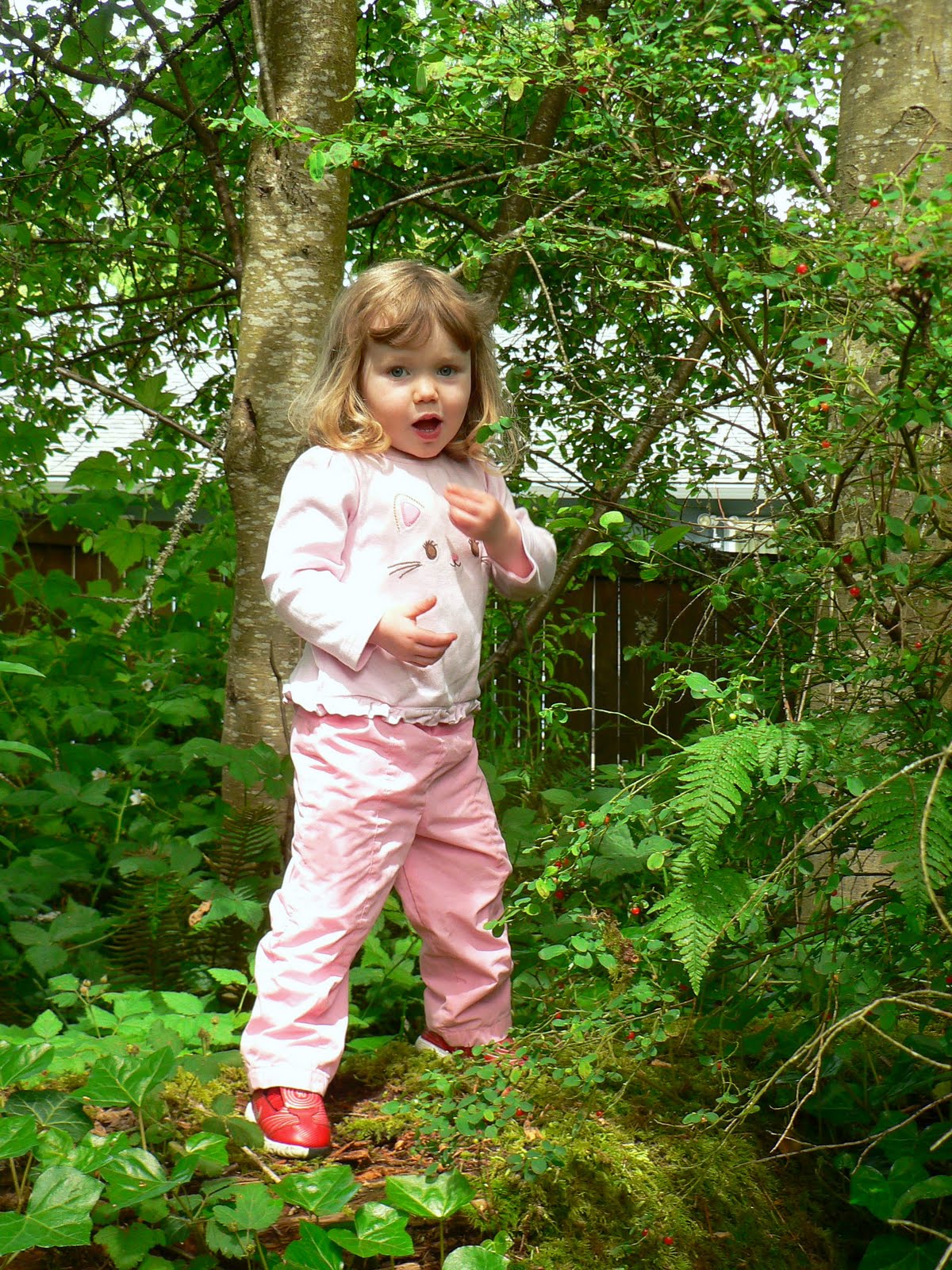
They loved it!  We've gone out almost every day the past week.  We found a real nice patch of huckleberries on the trail right behind our house.  On one trip Selena said, completely unprompted from me, "Picking berries is fun.  It is better than Halloween when we go and get candy from our neighbors."  How cute is that!  Allie has become a berry picking fiend.  She gobbles the berries faster than I can pick them and if we are lucky and find a bush that has some low berries she climbs right into the brush and snaps them off straight into her mouth.


Here is Allie stealing all the salmonberries we did manage to collect and gobbling them up before we could take them home and try to make something from them.

Allie is snagging them even when I'm trying to photograph them.


Red Huckleberries


Sorry the picture isn't that great.  I'll try to get a better one.  Red huckleberries like to grow out of nurse logs.  So sometimes the bushes can be way up high.  The bushes I have seen range from about 2 feet to 10 feet tall.  They have small red berries that progress in ripeness from white to green to pink to red.  They are supposed to be ripe from late July - October but there are some ripe ones right now.  So far all the ones I've eaten have been pretty sour, but the girls like them.  They tasted delicious in muffins.  You have to do a lot of picking to get a decent amount.


Salmonberries


I'm a little confused on the salmonberries.  There are supposedly yellow ones and red ones.  But around here I've been seeing both on the same bush.  So I'm not sure if they are both growing on the same bush or if the berries turn from yellow to red and the yellow ones aren't really ripe yet.  The yellow ones seem pretty sour while the red ones don't seem to have a whole lot of flavor.  I've also seen some red berries on totally different looking bushes and am not sure if they are also salmonberries or if they are wild raspberries.  This article said to avoid red ones, but I have no idea why.  The berry book just said there were two different kinds.  The bushes can be really tall.  Lots of the berries have been way over my head.  The bushes don't produce a whole lot of berries.  They supposedly ripen mid July to mid August, but there seem to be some ripe ones now.  The ones I managed to hide from Allie ended up in ice cream and tasted good.

Salal


I haven't tried this one yet since the berries are just now forming.  Salal starts out with little tiny white flowers that will eventually turn into blue berries.  It is a ground covering bush so it doesn't grow very tall.  We'll be on the lookout for these when they ripen.